At 10:59 AM on June 1, 2026, an explosion tore through Building 56 of Hanwha Aerospace’s facility in Daejeon, South Korea. The blast originated in a tool-cleaning room where workers were removing residual solid rocket propellant powder from production equipment. Five workers died. Two more were critically injured. By 1:07 PM, the fire was out. By market close, Hanwha Aerospace shares had fallen 2.98% to 1,138,000 KRW on the Korea Exchange — a roughly 10% reversal from that morning’s peak, which had been driven by rumors of new European arms contracts.
Six days earlier, Hanwha had stood at a podium in Sacheon and announced that South Korea would build its first domestically developed civil-military dual-use turbofan engine — a 4,500 lb.-class powerplant designed to propel the next generation of AI-driven Collaborative Combat Aircraft. The engine would integrate a shaft-mounted starter-generator capable of outputting 100 kilowatts of onboard power, enough to run the radar arrays, electronic warfare suites, and AI processing loads of an autonomous wingman operating alongside manned fighters like the KF-21. The 2029 prototype deadline was framed as a sovereign industrial milestone.
The interval between those two events — six days — is the precise length of Hanwha’s good news cycle. What followed is a case study in the structural contradictions inside one of the world’s fastest-growing defense exporters.
The National Forensic Service team that entered Building 56 on June 2 found what the Korea JoongAng Daily confirmed: the cleaning room where five workers died contained no automatic water sprinklers and no indoor CCTV cameras. A facility entrusted with the mixing, loading, and maintenance of solid rocket propellants for multiple-launch rocket systems and tactical surface-to-surface missiles was operating without two of the most basic industrial safety installations available. The absence was not a gap in an otherwise functional safety regime. It was the regime.
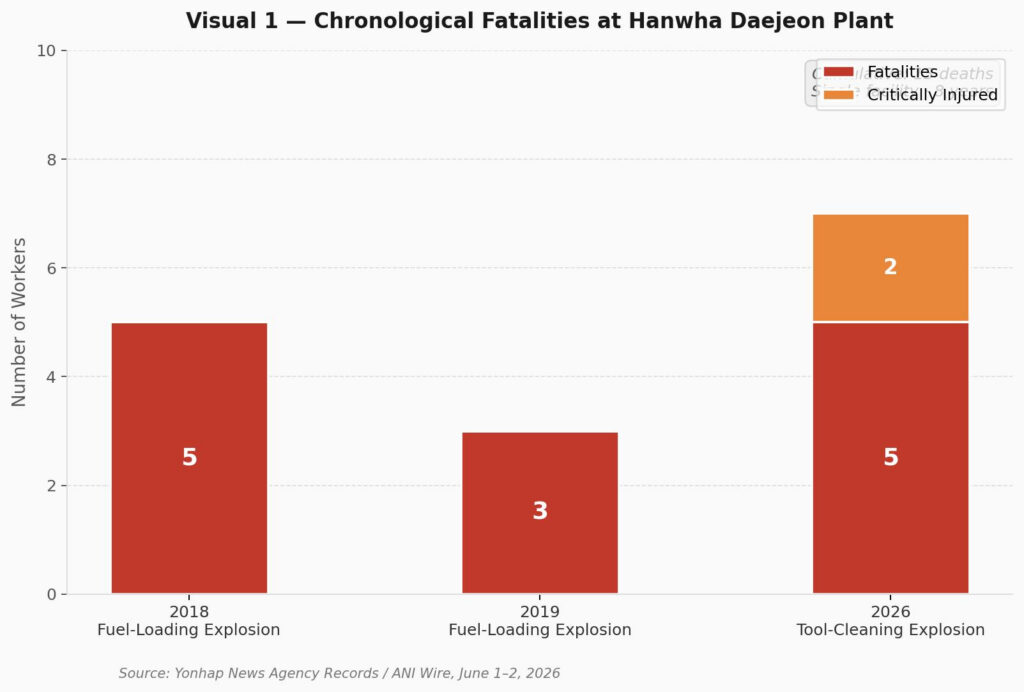
This is not Hanwha’s first time in this position at Daejeon. In 2018, an explosion at the same facility killed five workers. In 2019, another killed three. The June 1 blast brings the cumulative death toll from major explosions at a single Hanwha facility to thirteen workers over eight years. Yonhap News Agency records confirm all three incidents. The pattern does not suggest a series of unforeseeable accidents. It suggests a production environment in which the risk calculus has consistently tolerated human cost.
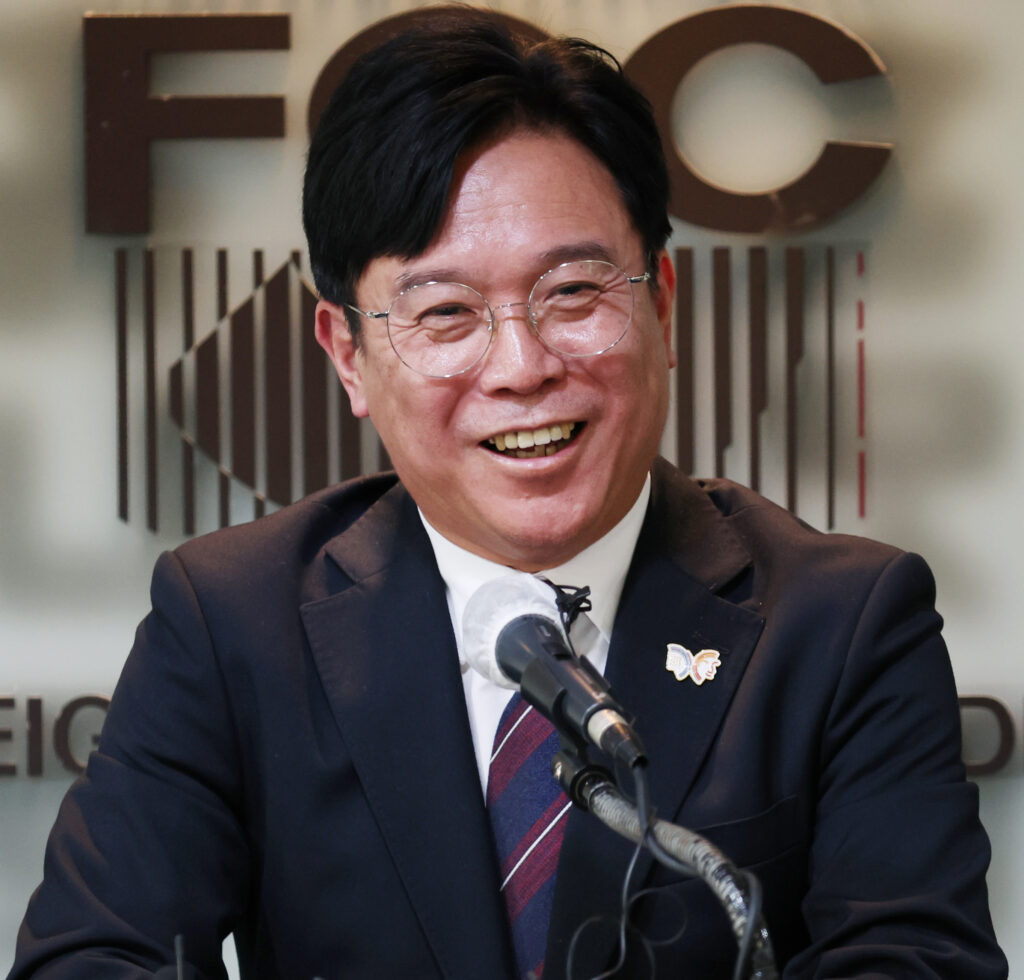
South Korean Minister of Employment and Labor Kim Young-hoon addressed this directly in his briefing to the Prime Minister on June 2: “Previously, accidents happened during fuel-loading operations, while the latest accident was reported to have taken place during the final cleaning stage. No workplace should be considered less dangerous.”
The Ministry has launched a formal investigation under the Serious Accidents Punishment Act — legislation with real teeth. The Act, revised in 2022 following a series of high-profile industrial fatalities, makes senior corporate executives personally liable for workplace deaths caused by safety negligence. A conviction can mean criminal prosecution, not just fines. The Ministry simultaneously imposed an immediate work stoppage at the Daejeon facility pending a structural safety review. Hanwha CEO Son Jae-il issued a public apology: “We bow our heads in apology to the victims and their bereaved families. Hanwha will do everything possible to handle the aftermath and cooperate fully with authorities.”
That statement will carry less weight in a courtroom than the photographs of Building 56’s ceiling, which show no sprinkler heads.
The technical irony embedded in this story has gone unreported in Western coverage. Hanwha is engineering a turbofan that integrates a 100 kW shaft-mounted generator — a sophisticated power architecture designed to meet the electrical demands of AI combat electronics that do not yet exist at scale. The engineering challenge is real and the solution is genuinely advanced. Meanwhile, the workers maintaining the company’s existing propellant lines were doing so without automatic fire suppression.
The 4,500 lbf engine program, developed jointly with the Korea AeroSpace Administration (KASA) and Korea Aerospace Research Institute (KARI), is designed around a dual-application architecture. The military variant is optimized for high-performance propulsion in CCAs — unmanned wingmen with a maximum takeoff weight of 10 to 13 tons in twin-engine configuration. The civilian variant pursues a high-bypass configuration for fuel efficiency in commercial small passenger aircraft and 10-seat business jets. Hanwha is running a parallel program for a 5,500 lbf low-bypass variant specifically for low-observable military applications.
This propulsion hierarchy places Hanwha at the center of South Korea’s defense-industrial ambitions for the 2030s. The FA-50 Golden Eagle flies on a 12,000 lbf F404 engine. The new CCA engine at 4,500 lbf represents a distinct sovereign capability tier, targeted precisely at the autonomous wingman class that the United States Air Force is building toward with its own CCA program. South Korea wants that capability domestically sourced. Hanwha is the designated vehicle.
The question defense procurement officials in Berlin, London, and Canberra are now asking is whether that vehicle is structurally sound enough to carry the weight.
Hanwha’s investor relations team and its corporate communications have moved quickly to contain the damage. Their core argument: the Daejeon explosion is geographically and industrially isolated from Hanwha’s advanced aviation programs. Gas turbine, aero-engine, and the new KASA turbofan work are anchored at the Changwon facility, which was not affected by the blast and is not subject to the Daejeon work stoppage. The company confirmed that core tactical rocket and jet engine production lines were operational throughout the crisis.
That argument is factually accurate. Changwon and Daejeon are separate facilities running separate product lines under separate safety regimes. The 2029 engine prototype timeline is not directly threatened by what happened in Building 56 on June 1.
But the Changwon insulation argument misreads how procurement decisions are made. When sovereign defense buyers evaluate a contractor for a long-cycle, high-stakes propulsion program, they are not assessing individual facilities in isolation. They are assessing institutional safety culture, legal exposure, and production reliability across the enterprise. A company facing criminal prosecution of senior executives under a Serious Accidents Punishment Act investigation is a company with leadership bandwidth allocated to legal defense, not program execution. A company absorbing its third fatal explosion at the same facility in eight years is a company whose safety management system has demonstrably failed to learn from prior incidents.
NATO procurement officers writing qualification criteria for domestic propulsion contracts do not treat those as separate questions.
The coverage split between Western and Korean outlets captures exactly this divergence. Reuters and Bloomberg are running the Daejeon explosion as a supply chain story — will the work stoppage delay Hanwha’s artillery and munitions deliveries to Germany and the United Kingdom? Korean outlets are running it as a labor and criminal liability story — will executives face prosecution, and why did Building 56 have no sprinklers?
Both framings are accurate and both are incomplete. The story is the gap between them: a defense contractor marketing 100 kW of AI-era electrical power for autonomous warfighters while operating propellant cleaning rooms without 20th-century fire suppression.
The date to watch is the Ministry of Employment and Labor’s formal ruling on Serious Accidents Punishment Act liability, expected within 60 days of the June 1 incident. If the ruling triggers executive-level charges, it will force a governance restructuring inside Hanwha Aerospace that will affect every active program, including the KASA engine project. If regulators accept Hanwha’s ring-fencing argument and limit the ruling’s scope to Daejeon’s propellant operations, the 2029 turbofan deadline survives — and South Korea’s high-tech defense export narrative absorbs the blast and continues.
Thirteen workers have now died in explosions at a single Hanwha facility. The ruling will determine whether that number is a tragedy or a liability.
Sources
- Korea JoongAng Daily. “As families await answers, investigators examine site of deadly Hanwha Aerospace explosion.” June 2, 2026. https://koreajoongangdaily.joins.com/news/2026-06-02/national/socialAffairs/As-families-await-answers-investigators-examine-site-of-deadly-Hanwha-Aerospace-explosion/2606824
- Dong-A Ilbo (via DBR). “Hanwha Aerospace Starts 4,500-Pound Civil-Military Engine Project.” May 26, 2026. https://dbr.donga.com/kfocus/view/en/article_no/2774
- Claims Journal (via Bloomberg/Yonhap). “Hanwha Aerospace Explosion Kills Five Workers, Lee Orders Probe.” June 2, 2026. https://www.claimsjournal.com/news/national/2026/06/02/337906.htm
- Evrim Ağacı (via eToday/Korea Exchange data). “Hanwha Aerospace Explosion Kills Five And Shakes Markets.” June 2, 2026. https://evrimagaci.org/gpt/hanwha-aerospace-explosion-kills-five-and-shakes-markets-540563
- Japan Today (via Reuters). “5 dead, 2 injured after explosion at aerospace plant in South Korea.” June 1, 2026. https://japantoday.com/category/world/five-dead-two-injured-after-blast-at-hanwha-aerospace-plant-in-south-korea
- Seoul Economic Daily. “Korea Forest Service Chief Launches Wildfire Prevention Campaign in Andong.” March 28, 2026. https://en.sedaily.com/society/2026/03/28/korea-forest-service-chief-launches-wildfire-prevention-20260328
- The Korea Times. “Korea deploys drones to regrow scorched woodlands.” May 27, 2026. https://www.koreatimes.co.kr/southkorea/environment-animals/2026/05/27/korea-deploys-drones-to-regrow-scorched-woodlands
