
How Embraer Quietly Built a Third Tactical Airlift Ecosystem Inside NATO
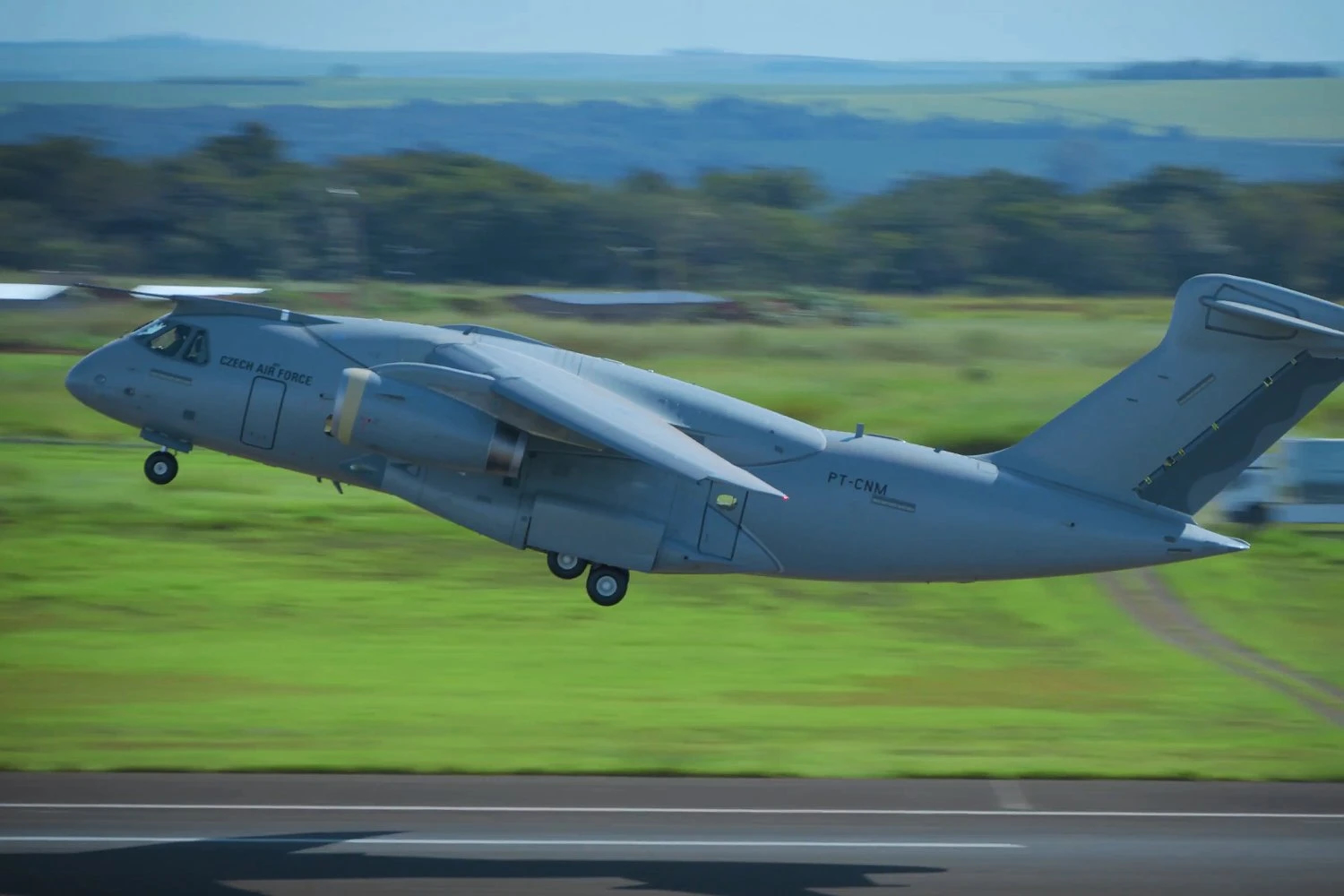
On May 11, 2026, an aircraft with the temporary registration PT-CMN lifted off from Embraer’s Gavião Peixoto facility in Brazil. It was the maiden flight of the Czech Republic’s first KC-390 Millennium — and most defense coverage treated it as a routine production milestone.
It was considerably more than that.
The flight marks a quiet structural shift inside NATO procurement. Smaller European states are assembling a tactical airlift ecosystem that sits outside the traditional American and Western European aerospace hierarchy — and the implications run deeper than any single aircraft sale.
Transport fleets are not simply aircraft purchases. They are logistics systems, maintenance economies, industrial alliances, training pipelines, and long-term political dependencies. When a country buys into a new platform, it buys into everything that surrounds it.

Prague’s October 2024 acquisition contract, valued at CZK 11.3 billion ($493 million USD), makes that point clearly. The deal includes an $82.3 million industrial offset package directed toward Czech aerospace firms — and those offsets are not symbolic. Aero Vodochody, one of the country’s most capable defense manufacturers, is embedded in the KC-390 production chain as a Tier-1 supplier, building the cargo ramp, front cabin doors, rear fuselage structures, and portions of the wing leading edges.
Czechia is not simply buying Brazilian transports. It is buying entry into the production architecture itself.
For decades, smaller NATO members operated inside one of two tactical airlift ecosystems: Lockheed Martin’s C-130J Super Hercules family or the Airbus A400M Atlas framework. Embraer is now building a third. Portugal, Hungary, Austria, the Netherlands, and Czechia are converging around the KC-390, and every additional operator expands the network — the maintenance base, pilot training interoperability, spare-parts ecosystem, and logistics depth that make a platform strategically durable.
The result is a growing form of strategic autonomy for mid-sized European air forces. They are no longer compelled to choose between Washington and Toulouse.
The financial picture explains why this program matters so much to Embraer. The company’s defense revenues surged 48% year-over-year to $345 million in the fourth quarter of fiscal 2025, according to Forecast International, driving its firm order backlog to a record $31.6 billion entering 2026. Much of that growth came directly from European KC-390 contracts moving through production. The Czech aircraft is a product of that momentum — and the momentum is accelerating. On May 4, 2026, the UAE Air Force finalized its own KC-390 procurement agreement. Lithuania is actively evaluating the platform. The program has left South America and Portugal behind; it is now spreading across multiple NATO-aligned states simultaneously.

There is one aspect of the Czech fleet that most financial analysts passed over entirely: configuration. Prague’s KC-390s are not optimized solely for military transport. They are being prepared for medical evacuation, humanitarian support, aerial refueling, and compatibility with the MAFFS II aerial firefighting system.
That dual-use positioning reflects a broader shift in European procurement logic. Governments face mounting political pressure to justify expensive military acquisitions against a wider set of domestic needs. A platform that moves troops during a NATO contingency and drops fire retardant during a severe wildfire season is a far easier sell to finance ministries and parliaments than a single-purpose combat aircraft. The KC-390 fits that requirement precisely.
Critics in traditional defense circles argue that firefighting missions place additional stress on airframes and dilute the readiness of high-value transport fleets. The counterargument is financial rather than ideological: many mid-sized European countries cannot afford separate fleets for every emergency mission. The KC-390 is a compromise between military utility and domestic resilience, and that compromise is becoming the dominant logic of European defense buying.
The Czech program also reveals something harder to quantify but more strategically significant: modern defense procurement is increasingly a competition over sustainment ecosystems, not aircraft. The real contest no longer ends at delivery. It revolves around who controls the maintenance depots, pilot training programs, mission systems integration, software support, spare-parts supply chains, and industrial participation that determine a platform’s long-term relevance.
Embraer appears to understand this clearly. The company has structured the KC-390 program around industrial integration rather than simple export dependency. Aero Vodochody’s participation gives Prague a material stake in the aircraft’s long-term success — local jobs, manufacturing capacity, and export revenue all become attached to continued sustainment and fleet expansion. That reduces political vulnerability and raises the cost of switching platforms.

It also introduces risk. Distributed manufacturing chains can slow production when smaller suppliers encounter bottlenecks. Initial reporting around the 2024 contract suggested delivery activity beginning in late 2025; the first aircraft actually completed its maiden flight in May 2026, a delay of six to nine months. That gap reflects supply-chain realities now affecting nearly every major military aircraft manufacturer in the post-pandemic production environment. Embraer is not immune.
The larger trajectory, however, favors the company. Its challenge is no longer proving the KC-390 can perform. It is proving that a Brazilian manufacturer can permanently embed itself inside NATO’s logistical bloodstream — inside the maintenance contracts, the training syllabi, the spare-parts agreements, and the industrial relationships that make an alliance’s transport capacity function.
The maiden flight of PT-CMN is one data point in that argument. The more important story is the network forming behind it: a distributed industrial structure linking Brazil, Portugal, Austria, Hungary, the Netherlands, and Czechia into a common tactical airlift framework that neither Washington nor Toulouse controls.
That network is taking shape faster than most defense coverage acknowledges.
Sources: Air Data News; Aerospace Global News; Forecast International; Embraer Corporate Media