

The KC-135 Stratotankers parked at Ben-Gurion Airport are easy to miss in the larger picture. Their formal extension through the end of 2027 drew a brief dispatch from the Jerusalem Post on May 18 and little follow-on coverage. But the tankers are not the story. They are the visible surface of a legislative architecture being assembled in Washington that will make the U.S.-Israel defense relationship structurally irreversible — not by treaty, not by executive order, but by contract law and supply chain physics.
The FY2027 National Defense Authorization Act, moving through the House Armed Services Committee toward a June 4 markup, contains two provisions that will define the bilateral relationship for the decade ahead. Section 224 creates a new bureaucratic organ — an “Executive Agent” — tasked with synchronizing U.S.-Israel joint weapons production and AI system integration. Section 151 authorizes multiyear procurement contracts for the F-15EX and F-35, replacing annual congressional lots with five-year commitments. Taken together, these sections do not deepen a security partnership. They fuse two defense-industrial bases at the production layer, where political reversals cannot easily reach.
The Mechanism
Section 224, drawn from the HASC FY27 draft released May 26, 2026, establishes what the bill calls a Defense Technology and Cooperation Initiative. The Executive Agent role it creates is not an advisory post. It is an operational coordination function with authority to synchronize acquisition timelines, integrate Israeli defense systems into U.S. supply chains, and manage joint AI development programs between the two countries’ defense establishments.
The significance of this structure lies in what it bypasses. International Traffic in Arms Regulations — ITAR — has historically functioned as the primary friction mechanism governing how U.S. defense technology moves to foreign partners. The process is slow by design: individual license reviews, end-use monitoring, congressional notification requirements. Section 224 does not eliminate ITAR, but it creates an institutional channel above it. An Executive Agent with cross-agency coordination authority can smooth and accelerate approvals in ways that individual program offices cannot. Analysts briefed on the draft text have noted that the provision gives Israel “unprecedented access to American technology” while simultaneously integrating Israeli systems — sensors, munitions, electronic warfare components — into American supply chains. The integration runs both directions.
That bidirectionality is the mechanism’s key feature. Once Israeli-origin components are embedded in U.S. systems at scale, the supply chain argument for maintaining the partnership becomes self-sustaining. Disrupting the relationship no longer requires only a policy decision. It requires identifying and replacing hardware already inside American platforms.
The Multiyear Shift
Section 151 of the HASC tactical aviation and land forces print, released May 16, addresses what the Pentagon has long identified as a structural inefficiency in major aircraft procurement. Annual authorization cycles force contractors to build production planning around one-year demand signals. The result is workforce instability, component supplier fragility, and unit cost premiums that the services pay year after year.
Secretary of the Air Force Troy E. Meink made the case plainly on May 21: “Year-to-year contract limitations are inefficient… multiyear procurement is ideally suited for the F-15EX.” The FY2027 budget request supports his argument with arithmetic: $2.656 billion for 24 F-15EX airframes, a per-unit cost that multiyear contracting would reduce by eliminating the annual restart penalties absorbed by Boeing and its tier-one suppliers.

The cost-efficiency case is real. It is also incomplete as an explanation for what multiyear authority actually does to the bilateral relationship. A five-year F-15EX contract signed in late 2026 or early 2027 creates legal obligations that run to 2031 or 2032. It locks Boeing’s St. Louis line into a production rhythm keyed to both U.S. Air Force and foreign military sales demand — Israel operates F-15s and is a customer for advanced variants. It creates contractual penalties for termination. It establishes a parts supply network across dozens of subcontractors whose business models are built around the contract’s duration.
Any administration that takes office in January 2029 and wishes to condition or curtail F-15EX deliveries tied to this contract faces not a policy decision but a breach-of-contract problem, a Boeing workforce problem, and a subcontractor bankruptcy problem. The multiyear authority converts political optionality into legal and economic constraint. That is precisely what it is designed to do. “Contractor stability” is the stated rationale. Supply chain lock-in is the structural consequence.
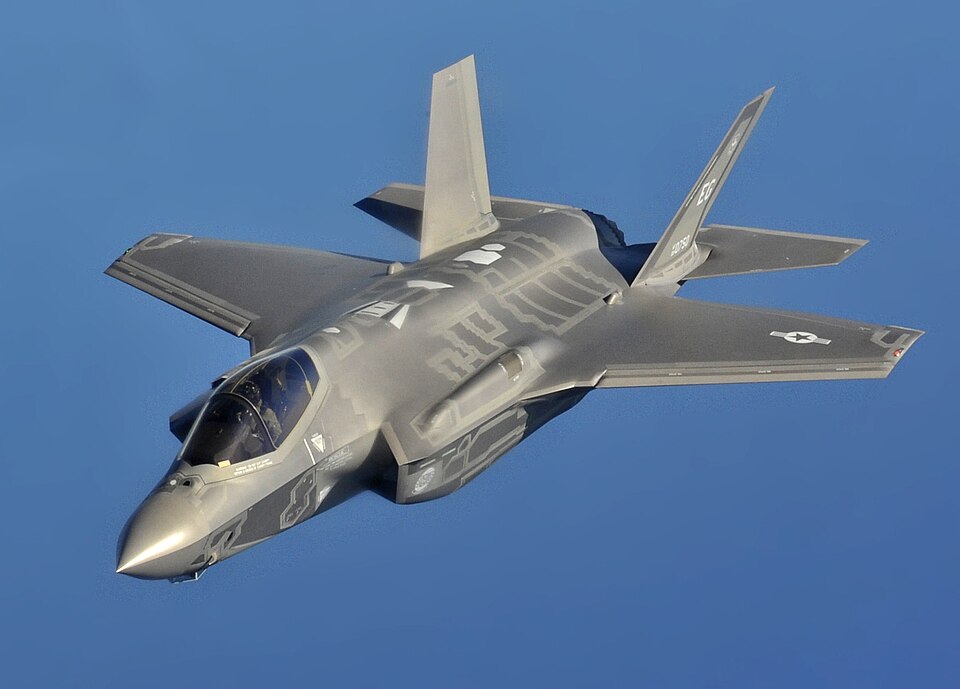
The F-35 dimension compounds this further. The F-35 program already operates as a global industrial consortium across nine partner nations. Adding multiyear authority for U.S. procurement lots strengthens Lockheed Martin’s production cadence and extends the sustainment tail on a platform Israel already flies. Every additional F-35 delivered under a multiyear contract is another airframe requiring U.S.-origin software updates, U.S.-managed depot maintenance, and U.S. supply chain support for its operational life. The sustainment relationship outlasts any administration’s term by twenty years.
The Counterargument
The defense industry’s case for these provisions is not cynical. Lockheed and Boeing have genuine production efficiency arguments, and the regional deterrence rationale for a well-armed Israeli air force is not invented. Iran’s ballistic missile and drone programs have expanded materially since 2020. The October 2023 attacks and subsequent regional escalations demonstrated that Israeli air power absorption capacity has direct consequences for U.S. force posture in the region — fewer Israeli sorties means more American ones.
The KC-135 stationing at Ben-Gurion is a direct expression of this calculus. American tankers forward-deployed to Israeli soil extend the combat radius of Israeli platforms and reduce the demand on U.S. carrier air wings. From a pure operational standpoint, deeper industrial integration with a partner whose threat environment is this demanding makes planning sense.
The counterargument’s limitation is not that it is wrong. It is that it is presented as the full account when it is only part of one. Cost efficiency and regional deterrence explain why defense planners favor these provisions. They do not explain why structuring them as multiyear contracts and Executive Agent authorities — rather than annually reviewed assistance packages — is the preferred legal vehicle, unless the preference for irreversibility is itself part of the design.
The Point of No Return
The June 4 HASC markup is the legislative moment that transforms these provisions from draft text to enacted architecture. Once Section 224 and the multiyear authorities clear committee with the support of the full House Armed Services majority, the path to floor passage and conference with the Senate becomes largely procedural. NDAAs pass. They have passed every year for over sixty consecutive years.
What will not pass back through the same door, once closed, is the option to treat U.S.-Israel defense ties as a relationship subject to ordinary diplomatic conditioning. Security assistance can be withheld. Weapon shipments can be paused. Arms can be made a lever. Industrial integration — the kind where Israeli components are inside American systems and American contracts are running Israeli production lines — cannot be unwound by a president, a secretary of state, or a congressional resolution. It can only be unwound by lawyers, over years, at enormous cost to American defense primes and their subcontractors.
The tankers at Ben-Gurion will eventually rotate home. The supply chain they represent will not.
Sources
- House Armed Services Committee. FY2027 NDAA Draft — Section 224, Defense Technology and Cooperation Initiative. May 26, 2026.
- House Armed Services Committee. Tactical Aviation and Land Forces Subcommittee Print — Section 151, Multiyear Procurement Authority. May 16, 2026.
- Department of War (DoD). FY2027 Budget Request — F-15EX Procurement Line. April 2026.
- The Jerusalem Post. U.S. KC-135 Tankers Extended at Ben-Gurion Airport Through End of 2027. May 18, 2026.
- Troy E. Meink, Secretary of the Air Force. Statement on Multiyear Procurement. May 21, 2026.
- The New Arab. Analysis: FY2027 NDAA Defense Technology Cooperation Provisions. May 31, 2026.