

How federal staff cuts and procurement freezes left America’s aerial firefighting fleet at risk
Emergency Management & Procurement Desk
Cameron Hamilton got confirmed as FEMA Administrator on August 7. A few hours later, Congress left for a five-week recess, right as hurricane season peaks and Western wildfires are running about as bad as they’ve run in years. The confirmation filled a chair that had been empty or contested for more than a year, but that vacancy did nothing to fix what’s underneath it.

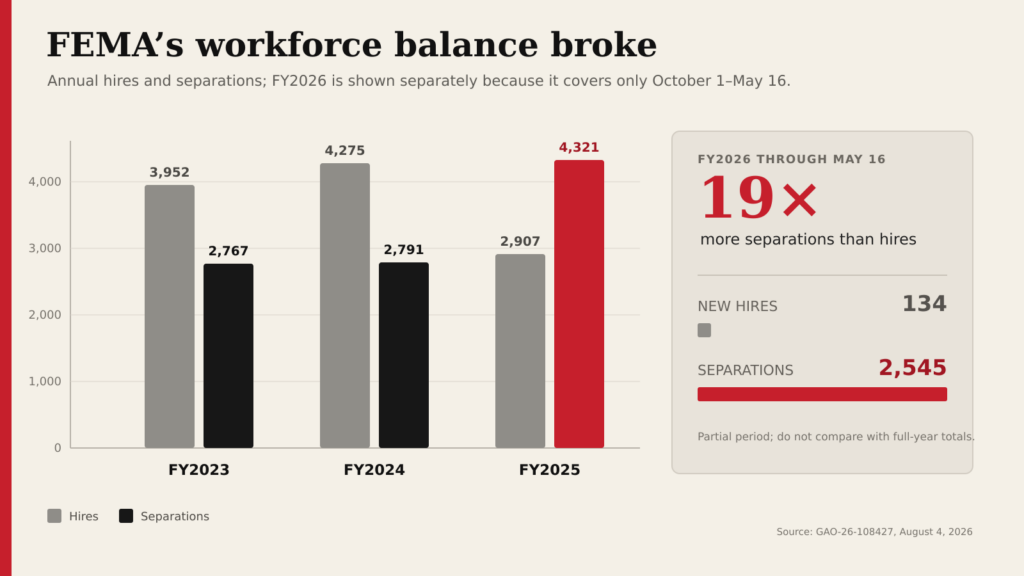
What the former Navy SEAL and returning FEMA Administrator is walking into is an agency that lost 17 percent of its staff, more than 4,300 people, over the past year and a half. The Government Accountability Office put a number on it in an August 4report. T GAO’s language was blunt. FEMA “may not have a workforce capable of effectively responding to disasters now or in the future,” and without workforce planning, the agency has no way to know if it has “the right number of people with the right skills in the right positions at the right time.”
FEMA doesn’t fly airtankers, but it sits at the front of a pipeline that ends with a contracting officer at the Forest Service signing off on a heavy-maintenance contract for one. Break either end and the whole chain stalls.
The Forest Service took its own hit in March. The Department of Agriculture announced it would shut down the Washington office, eliminate nine regional offices, and give roughly 6,500 employees a choice: move to Salt Lake City or leave. The federal employees’ union calls it a disguised layoff. Whatever it’s called on paper, an agency in the middle of relocating its own headquarters isn’t issuing new task orders, and the contractors who convert and maintain airtankers need those orders to plan maintenance more than a quarter out.
The people still fighting fires are reading the situation the same way. Representative Joe Neguse stood with wildland firefighters and union leaders in June and cited a shocking statistic: three out of every four active federal wildland firefighters are thinking about quitting, driven by what he called “irresponsible and reckless staffing and budget cuts” that have left workloads unsustainable and trust in agency leadership thin. A fleet is only as ready as the crews loading and inspecting it. You can’t keep a fleet flight-ready on a workforce that’s already halfway out the door.
Here’s the part that turns a staffing problem into a grounded plane. Federal agencies have been running on stopgap continuing resolutions, and a CR carries a specific legal handcuff: no new multi-year contracts, no expanding maintenance schedules past what’s already funded. The Pentagon’s own procurement guidance says as much. Under a CR, “we are unable to begin new programs or projects,” and stopgaps are “wasteful to the taxpayer” because they cut purchasing power. A tanker operator waiting on a multi-year MRO order to justify spending on an engine overhaul is waiting on an agency that’s legally barred from signing one until the CR lifts.
The administration’s defenders will point out that emergency flight hours don’t come from the regular budget at all. They come from the Wildfire Suppression Operations Reserve Fund, built specifically to sit outside the annual caps so one bad season doesn’t blow a hole in the budget. That would seem like a fair argument, were it not for the fact that that fund pays for flight hours once a plane is airworthy and sitting on the ramp. It does no‘t pay for the depot maintenance or the engine overhaul that gets it there, because that work runs through the same short-staffed contracting offices and the same CR restrictions as everything else. Flight hours with no budget cap don’t help an airplane stuck in a hangar because nobody was authorized to sign its maintenance contract.
December 11 is the date to watch, not Hamilton’s confirmation hearing or the next Forest Service press conference. That’s when the current continuing resolution runs out, and Congress either funds these agencies on a real multi-year basis or passes another stopgap and drags the freeze through next year’s fire season planning. Congress will be back by then. Whether it spends the time fixing the pipeline or just arguing over who broke it is the thing worth watching between now and then.


Sources
Editor’s note on sourcing
The GAO report, its core finding that FEMA cut staff without a workforce capability assessment, the more-than-4,300-employee separation figure, the March 31 Forest Service headquarters relocation to Salt Lake City, and the Neguse quote used here were independently verified against GAO.gov, NFFE’s own reorganization hub, and Neguse’s official press release. One correction from the original assignment brief: the quote “this is a dismantling of a beloved 120-year institution” could not be verified as Rep. Neguse’s; the same press event’s “dismantling” language was actually spoken by NFFE National President Randy Erwin. This draft uses only the verified Neguse quote. The exact $438 million/24 percent USFS budget figure, the specific incident-management workforce availability percentages, the December 11 CR deadline, the Hamilton confirmation date, and the firefighter pay figures were carried over from the original brief or reconstructed from union pay tables and were not fully re-verified against primary outlets during this research session. Confirm these before publication.